

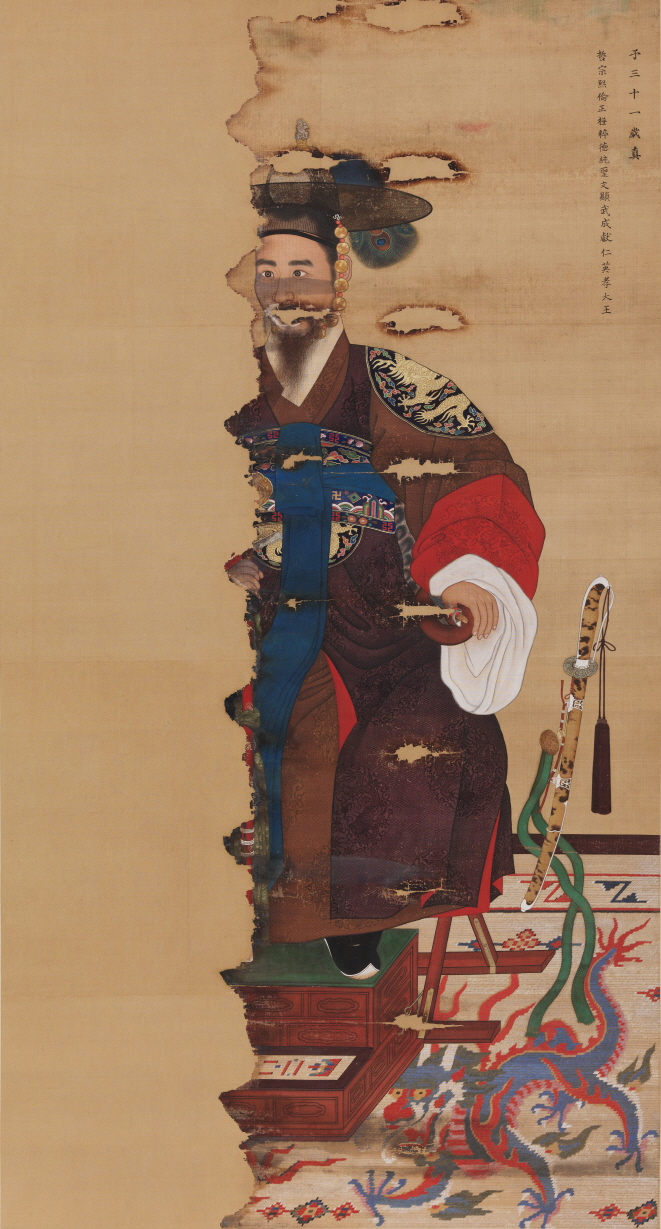
Portrait of King Cheoljong
- Date
- 1861
- Author
- Yi Han-cheol, Jo Jung-muk, Kim Ha-jong, and others
- Dimensions
- Image 202×93.0cm
- Designation Type
- Treasure
- Designated Date
- December, 29, 2006
- Holder
- National Palace Museum of Korea
- Related Links
- National Palace Museum of Korea Quick Link
Overview
This is a portrait of King Cheoljong (哲宗, r. 1849–1863), the twenty-fifth monarch of the Joseon Dynasty. When King Heonjong (憲宗, r. 1834–1849) passed away without heirs, Cheoljong, who had been a farmer, was suddenly elevated to the throne at the age of nineteen. During his reign, Cheoljong failed to gain much political power or successfully stabilize state affairs. This Portrait of King Cheoljong was produced in 1861, the year he was thirty-one. One-third of the left section was destroyed in a fire during the Korean War. The upper-right portion of the paintings still bears a title written by King Cheoljong reading “Portrait of myself at thirty-one” (予三十一歲眞), indicating its production year. King Cheoljong is shown in this portrait wearing a military uniform and a jeollip (military felt hat) while sitting in a chair. This depiction provides detailed information about a Joseon king’s military attire. The uniform worn by kings is similar in style to that of civil and military officials, but the royal version is more ornately decorated with gold threads, five-colored embroidery, jade ornaments, and peacock feathers. In this work, Cheoljong is depicted holding a military official’s baton called a deungchae in his right hand and with an archery thumb ring used to pull a bow in his left thumb. Behind the chair is a royal sword leaning against the wall. Cheoljong is equipped with these military items along with his uniform. The use of moderate shading in the face and clothing allows well-ordered and realistic expressions of the subject. Another notable feature of this portrait is the utilization of a characteristic Joseon-era coloring technique for portraits called baechaebeop. In it, colors are applied to the back of the silk, allowing them to subtly show through the fabric. For example, an apricot hue was heavily painted on to the reverse side of the face, with outlines and shading subsequently added from the front. In the clothing, various colors were first applied from the back to large color fields, followed by the addition of designs and shading from the front. Coloring both the front and back of the silk enriches the colors and produces both a sense of three-dimensionality and of decorativeness. As the sole extant royal portrait of a king in a military uniform, this painting can assist with the study of royal portraits and military clothing.