


Giyeonghoedo (Gathering of Elders)
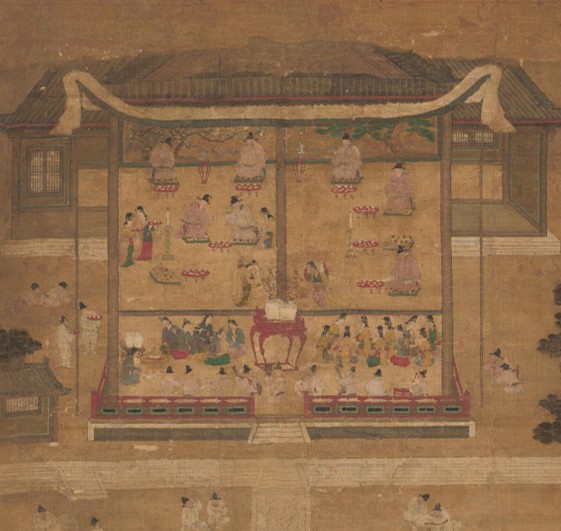
- Artifact Title
- Giyeonghoedo (Gathering of Elders)
- Date
- 1584
- Dimensions
- 128.5x163cm
- Designation Type
- Treasure
- Designated Date
- October, 25, 2001
- Holder
- National Museum of Korea
- Related Links
- Quick Link
Overview
During the Joseon Dynasty, get-togethers at which officials could develop personal friendships were often held. These gatherings were called gyehoe in Korean. When such meetings were considered especially meaningful, it was customary for paintings of them to be produced and shared among participants. In the centuries before photography, such paintings played the role of commemorative photographs. In other words, paintings of officials’ gatherings were intended as a medium to help preserve the memory of them for a long time. This work was created to commemorate a regular gathering held in 1584 by members of the Giroso (Club of Senior Officials). There are a few surviving examples of depictions of gatherings of elders from the sixteenth century. Among them, this painting designated as a treasure is considered to exhibit the highest level of artistic achievement. Mounted on a hanging scroll, it features a three-tiered composition with a title in the upper section, an image of the gathering in the middle section, and a list of participants and their personal information in the lower section. A close look at the painting suggests that the banquet for the gathering was held inside an office at the Giroso. As the main building in question, the Giroso office is depicted on a large scale. It is divided between a primary space where the senior officials are shown and an annex containing the maids and musicians. While the building itself is rendered from a frontal perspective, the interior is portrayed using a bird’s-eye view to emphasize the spatial layout. The natural depiction of motion and facial features in the figures stands out, and objects are delineated with delicate lines and exquisite coloring. Beyond the senior officials, figures responsible for different duties are naturally illustrated in detail wearing clothing with colors corresponding their social standing. This work presents a different composition compared to officials’ gathering paintings from the first half of the sixteenth century in which the figures are depicted on a small scale and the background occupies a large portion of the composition. Moreover, the inclusion of various scenes related to customs provides insight into diverse aspects of the society of the time.