


Gisa gyecheop (Album of Paintings of the Gatherings of Elders)
- Artifact Title
- Gisa gyecheop (Album of Paintings of the Gatherings of Elders)
- Date
- 1719
- Author
- Kim Jin-yeo, Jang Tae-heung, Bak Dong-bo, Jang Deok-man, Heo Suk, and others
- Dimensions
- Overall 53.3×37.5cm
- Designation Type
- National Treasure
- Designated Date
- December, 22, 2020
- Holder
- Private Collection
Overview
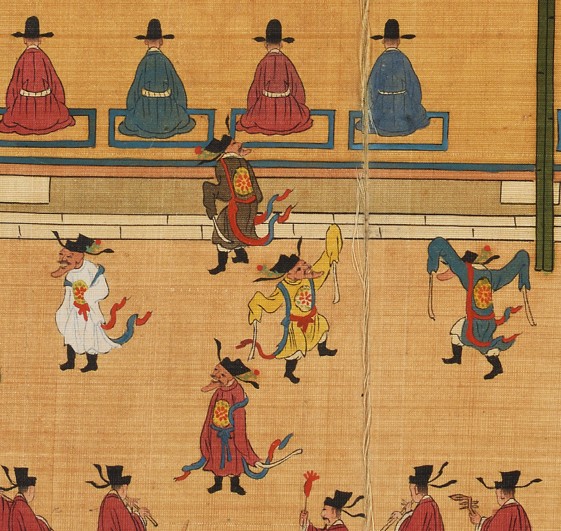
This album was produced to commemorate the 1719 entry of King Sukjong (r. 1674–1720) into the Giroso (Club of Senior Officials). It includes scenes from the event celebrating his entry, a poem composed by the king for the event, portraits of participants, and their poems. Its production was completed in 1720. The documentary paintings and portraits in this album were created by the foremost court painters of the time from the Dohwaseo (Royal Bureau of Painting) and executed with great technical virtuosity, as exemplified by the exquisite brushwork. In addition to this virtuosity, the handwritten poems composed by several of the king’s subjects enhance the artistic and historical value of the album. The fifty-four leaves of the album include documentary paintings illustrating five different scenes. Each is portrayed realistically in dynamic brushwork across two leaves. The five scenes are a procession of senior officials from Heungjeongdang Hall at Gyeonghuigung Palace to the Giroso Club on their way to enshrine an album bearing calligraphy of the king’s honorific name (御帖奉安圖); senior officials performing a celebratory royal ceremony in Sungjeongjeon Hall at Gyeonghuigung Palace (崇政殿進賀箋圖); a banquet held by the king for senior officials at Gyeonghyeondang Hall (景賢堂錫宴圖); the procession of senior officials returning to the Giroso Club with silver cups bestowed by the king at the banquet (奉盃歸社圖); and a further banquet at the Giroso Club (耆社私宴圖). The names of the calligraphers and painters are not conventionally presented in royal documentary paintings, but this album contains the names of five court painters (Kim Jin-yeo (dates unknown), Jang Tae-heung (?–after 1729), Bak Dong-bo (1688– after 1729), Jang Deuk-man (1684–1764), and Heo Suk (1688–after 1729)), a production supervisor, and a calligrapher, heightening its significance. Several versions of such documentary paintings designed to commemorate royal court events were produced. Some were made for viewing by the king, and others were intended for distribution to the subjects who participated in the events. In the case of this album, twelve editions were created. One was stored at the Giroso Club and the rest were given to eleven senior officials. Along with this album in the collection of the National Museum of Korea, similar versions are found at the Ewha Womans University Museum and in a private collection. This album is particularly significant since its inner case, leather bag, and outer case have all survived. It bears additional inscriptions reading “Collection of Mantoedang” and “Passed down to and treasured by the family.” They indicate that the album had been cherished by Pungsan Hong clan, to which Hong Man-jo (1645–1725) belonged, for the roughly 300 years since his entry into the Giroso Club and the bestowal of this album in 1720.