


Donggwoldo (The Eastern Palaces)
- Artifact Title
- Donggwoldo (The Eastern Palaces)
- Date
- 19th century
- Dimensions
- 561x273.5cm
- Designation Type
- National Treasure
- Designated Date
- June, 29, 1995
- Holder
- Seokdang Museum of Dong-A University
Overview
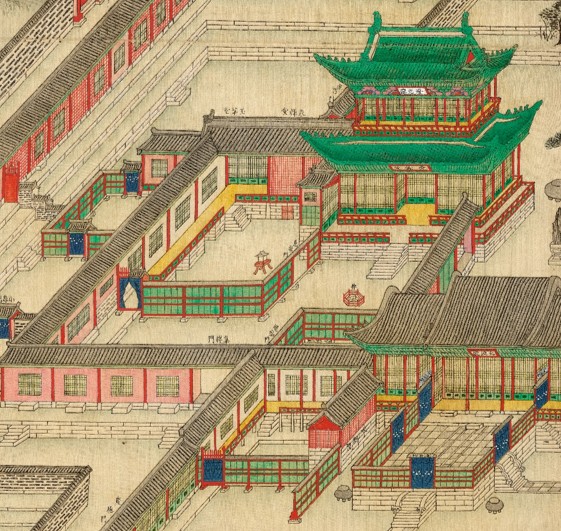
The Eastern Palaces depicts the layouts, rear gardens, and surrounding geographical features of the Eastern Palaces during the late Joseon period. The term Eastern Palaces refers to Changdeokgung and Changgyeonggung Palaces. Among the royal palaces built during the Joseon Dynasty, these are the two where the kings resided for the longest period. The exact production background, date, purpose, and court painters involved with The Eastern Palaces are unknown. However, the investigation into related archival materials, the names on the hanging boards hung at the buildings depicted, and whether or not the buildings were later destroyed suggests that this painting may have been created during the reign of King Sunjo (r. 1801–1830). It definitely shows the appearances of the Eastern Palaces from 1828 through 1830, which implies that Crown Prince Hyomyeong (1809–1830), who started his regency in the third lunar month of 1827, would have ordered its production. Currently, there are two surviving copies of The Eastern Palaces, one at the Dong-A University Museum and the other at the Korea University Museum. In both, rough initial sketches were drawn in ink on silk and then colored in. The former example is mounted in a folding screen format, but the latter retains its original concertina-fold book format. Sixteen concertina-fold books form a single set. Given its format and the large size of the pages when unfolded, The Eastern Palaces was likely intended to be viewed by unfolding only the sections the viewer wished to explore rather than the conventional manner of spreading out the entire work. Both editions of The Eastern Palaces were created in the color painting style and meticulous brushwork, both of which were often employed by court painters. The buildings are rendered precisely using the gyehwa (fine-line architectural drawing) technique, and the depiction of the details of the buildings stands out. They are like painterly maps in that the layout of the actual buildings at these palaces was depicted with a panoramic composition and the names of the buildings have been included. They can also be viewed as architectural paintings in that they are themed around the architectural structures and rear gardens of royal palaces. Moreover, the depictions of the actual buildings, geographical features, and trees of the Eastern Palaces using texture techniques and colors reflect real-view landscape painting. The use of the seolchae technique, which involves the application of color to a layer of black ink, demonstrates the influence of Western art. As a case in point, green is added to depict the grounds where the buildings stand, and blue is applied to the black ink layer to portray water. The most striking difference between the two versions is the use of color tones and the application of the seolchae technique. The Dong-A University edition features light color tones and a relatively simple color palette, resulting in a gentle atmosphere. On the other hand, the Korea University edition exhibits strong, deep coloration. In the latter, the application of dark green instead of light to the boundaries between the buildings and grounds is noticeable. The Eastern Palaces is significant for its demonstration of the advanced brushwork and compositions executed by court painters specializing in architectural paintings during the late Joseon period.