


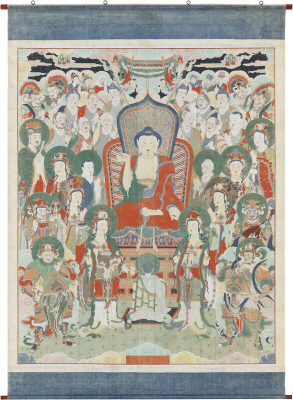
The Vulture Peak Assembly Gwaebul at Cheongnyongsa Temple(靑龍寺 靈山會 掛佛幀)
- Date
- 1658년(효종 9)
- Designation Type
- Treasure
- Monk-Painters
- Sagwa, Bakran, Myeongok, Eungsang, Jeongsim, Beopneung
- Dimensions
- Total 920×650cm, Image 737×610cm
- Designated Date
- 1997-08-08
- Holder
- Cheongnyongsa Temple
Overview
This gwaebul depicts the Vulture Peak Assembly in which Shakyamuni Buddha preaches on Vulture Peak. It is a group image featuring Shakyamuni Buddha surrounded by Bodhisattvas, the Ten Great Disciples, the Four Heavenly Kings, Eight Classes of Divine Beings, and Vajra Guardians. In front of the altar on which Shakyamuni is sitting is a listener who is hearing the dharma he requested from Shakyamuni. Such a depiction of a listener in the appearance of a monk can also be found in The Vulture Peak Assembly Gwaebul at Yeongsusa Temple in Jincheon (1653) and The Assembly of the Three Buddhas Gwaebul at Chiljangsa Temple (1710). This gwaebul shares similarities in the iconographical arrangement and depictions of the figures with The Vulture Peak Assembly Gwaebul at Yeongsusa Temple in Jincheon that was created by the monk-painters Myeongok and Beopneung, both of whom joined the production of this example, in 1653. This work, however, presents a simpler composition with a smaller number of figures. Shakyamuni Buddha sitting in a full-lotus (cross-legged) position on an altar is making the Dharmachakra (turning the Wheel of Dharma) mudra with his left hand placed over his left knee and his right hand raised to shoulder height. He has a thin face with a narrow space between his eyebrows and small eyes and mouth. His blue head is depicted with a gem in the shape of a wish-granting jewel at the top of a cranial protuberance (ushnisha) and another semicircular jewel in the middle of his head. The red outer robe covering his shoulders is adorned with yellow scroll patterns set within circles. The undergarment covering his chest has flower patterns in gold leaf. Shakyamuni’s mandorla consists of a head halo and body halo. The inside of the blue-edged head halo is filled with lotus and scroll patterns. Five-colored auspicious energy fills the inside of the red-edged body halo. In front of the canopy above the head halo of Shakyamuni are two Buddhas with their hands together in prayer and with their bodies turned slightly to the sides while looking down. To the left of the canopy are four of the Buddhas of the Ten Directions and three of them are on the right. All of them are descending on clouds. Around the head halo of Shakyamuni are Dragon King and Dragon Maiden, four of the Eight Classes of Divine Beings, four Vajra Guardians, four of the Buddhas of the Other Realms, and eight disciples arranged symmetrically in three rows. The subordinates below them (two heavenly beings, Ananda, Kasyapa, six Bodhisattvas, and the Four Heavenly Kings) all have circular head halos. Except for the transparent head halos on two Bodhisattvas, the rest are colored in green. Inscriptions are recorded inside a red cartouche in the lower-center section of the painting and on the left and right sides of its lower edge. The inscription inside the cartouche states that a gwaebul was produced at Cheongryongsa Temple on Seounsan Mountain to the south of Anseong in the fifth lunar month of the Musul year (1658), the fifteenth year of the Shunzhi era. It also relates a prayer for the king, queen, and crown prince. The inscription in the right of the border lists the names of current and former head monks of Cheongryongsa and other monks as well. The inscription on the left records the names of donors and people who participated in the project. A total of five monk-painters took part in the creation of this gwaebul with Bakran as head monk-painter. The others were Myeongok, Eungsang, Jeongsim, and Beopneung.
Inscriptions
(Center) [A gwaebul painting] was produced in the 5th lunar month of the Musul year (1658), the 15th year of the Shunzhi era. [I] treat it with respect. May the king live long. May the dowager queen live long. May the queen lead a long life as well. I pray that the life of the crown prince continues for a thousand years. The seongju (local magistrate) Kim Hong-seok and his wife, who donated hyangdae*(a pouch for containing deposited votive objects) This is the gwaebul painting from Cheongnyongsa Temple on Seounsan Mountain in the south of Anseong. (Left) Monk Gyeongsun, who served as the head monk (juji*) at the time Monk Beopyeol, who formerly served as the head monk (juji*) Monk Naun, who assumed three managing or operating positions Monk Tanhui, Monk Deokyu, Monk Gakneung, Monk Jinsu, Monk Gakseom, Monk Seonghui, Monk Eungcho, Monk Taeeon, Monk Sungam, Monk Neungmin (Right) Yi Jong-hang and spouse, who made a substantial donation of materials for a Buddhist painting Su Yeong-bi and spouse, who made a substantial donation of materials for a Buddhist painting Kim Eot-nam and spouse, who donated a great volume of goods to be used by the public Seunghwa and spouse, who donated a great volume of goods to be used by the public The daesa*(monk of eminent virtue) Monk Cheondam, who made a substantial donation of materials without any conditions An Dae-bok and spouse, made a substantial donation of materials without any conditions Choe Gyeong-nam and spouse, who donated a great volume of gold Bak Chung-rip and spouse, who donated gold People who participated in the Buddhist project Monk Gakheung, who examined whether the Buddhist project was being performed properly Those who produced the gwaebul painting are Bakran (who holds the post of Sagwa*), Monk Myeongok, Monk Eungsang, Monk Jeongsim, and Monk Beopneung. Monk Sangjong, Monk Jeongsang, and Inrye (alone), all of whom procured goods to be used by the public Monk Boeun, who served as a liaison in and outside the temple Monk Sail, who supervised affairs in the kitchen compound The sanin* Gakhae, who made a major contribution to the Buddhist project Glossary of Gwaebul Inscriptions * hyangdae 香臺: A pouch for containing bokjang (deposited votive objects) * juji 住持: A thin decorative edge of a different color on a table cover or scroll * sagwa 司果: A military official position with senior sixth rank within the Five Military Commands (Owi) during the Joseon Dynasty * sanin 山人: A monk who joined the sangha (monastic communities) in Buddhism