


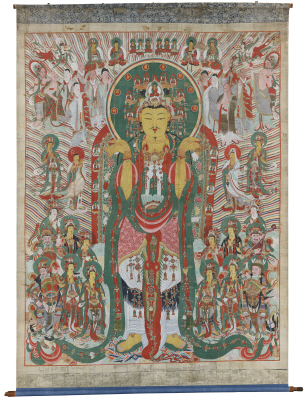
The Rocana Buddha Gwaebul at Sudeoksa Temple(修德寺 盧舍那佛 掛佛幀)
- Date
- 1673년(현종 14)
- Designation Type
- Treasure
- Monk-Painters
- Eungyeol, Okjun, Hakjeon, Seokneung
- Dimensions
- Total 1,071×744cm, Image 907×700cm
- Designated Date
- 1997-08-08
- Holder
- Sudeoksa Temple
Overview
This gwaebul painting is a group image featuring Rocana Buddha in the center surrounded by a symmetrical grouping of forty-two subordinates, twenty-one on each side. It was produced by monk-painters including Eungyeol, Hakjeon, and Seokneung. They seem to have used the identical model as The Rocana Buddha Gwaebul at Sinwonsa Temple, which they painted in 1664. However, ten more subordinates were added to this gwaebul. Rocana Buddha is depicted here wearing a crown embellished with nine Nirmana Buddhas (transformation Buddhas), with beaded ornaments adorning his body, and making the Dharmachakra (turning the Wheel of Dharma) mudra by raising both hands to shoulder level. Inside the green head halo of Rocana is written his name “Perfect Reward Body of Rocana Buddha,” with each Chinese character inside a circular cartouche. The edge of the body halo has flame patterns and four Nirmana Buddhas on each side. The inside of the body halo is decorated with peony patterns. In the uppermost section of the painting are six Buddhas of the Other Realms, two Buddhas, two Bodhisattvas, and two apsaras. Below them are two Pratyekabuddhas, the Ten Great Disciples, and two Vajra Guardians arranged symmetrically. Among the Ten Great Disciples, Kasyapa and Ananda each have a transparent head halo with a white outline, which differentiates them from the other disciples. In the middle of the painting are Avalokiteshvara Bodhisattva and Kshitigarbha Bodhisattva, each with a red head halo, and another pair of Bodhisattvas with green head halos. The lower portion of the painting exhibits Manjusri, Samantabhadra, Suryaprabha, and Candraprabha Bodhisattvas, four other Bodhisattvas, Brahma, Indra, and the Four Heavenly Kings. The blank spaces filled in with auspicious energy in varied colors is another similarity with The Rocana Buddha Gwaebul at Sinwonsa Temple. This painting has no separate cartouches for the inscriptions, but its lower edge bears an inscription recording donors, creators, people who fulfilled other duties, and some repairs done on the painting. According to the inscription, a Vulture Peak gwaebul painting was produced in the fourth lunar month of the Gyechuk year (1673), the twelfth year of the Kangxi era, for Sudeoksa Temple on Deoksungsan Mountain. It indicates the production date and place of enshrinement of the painting and relates that the painting was repaired in 1767, 1780, 1801, and 1888. The painting was created by the four monk-painters Eungyeol (as head monk-painter), Okjun, Hakjeon, and Seokneung.
Inscriptions
The complete and perfect reward body of Rocana Buddha In early summer of the Gyechuk year (1673), the 12th year of the Kangxi era, the production of a Vulture Peak gwaebul painting was completed. Choe Heung-rip and spouse, who donated many pieces of cloth for use as a support material for the Buddhist painting(batang*)and a great volume of goods for public use Monk Gyeongsin(boche*), who donated a great volume of goods to be used by the public Bak Jat-geum, who donated a great volume of goods to be used by the public Bak San-mae(boche*) and spouse, who donated a considerable amount of vermillion pigment Choe Jeong-won(boche*) and spouse, who donated a great volume of gold Hwang Gi-saeng(boche*) and spouse, who donated a great volume of goods to be used by the public Those who made material donations without any conditions are Bak Pung-i and spouse, Kim Sun-i and spouse, Jeon Song-yang and spouse, Jeon Ut-ji, U Dong-geum and spouse, Munmyeong Gu-ji and spouse, Choe Eup-se and spouse, Hwang Dae-seon and spouse, Kim Gye-in and spouse, Seon Geum-ui and spouse, Choe Cheon-deuk and spouse, and Kim Cheon-nae and spouse. Yun Si-hyeong and spouse, who donated a round mirror Choe Chu-hyeon and spouse and Okchun, all of whom donated round mirrors Kim Seon-i and spouse and Choe Seok-dan and spouse, all of whom donated salt Kim Bo-in and spouse and Kang Se-nam and spouse, all of whom donated blocks of fermented soybeans Yi Eung-yeon and spouse and a person with the family name Seon, all of whom donated pearls The yeongga*(soul) of Choe U-eumdeok, who donated lotus flowers Those who donated goods to be used by the public are Monk Hojun, Monk Ssangrip, Monk Seongan, Monk Sujing, Monk Doheon, Monk Chanin, and Monk Yeomyeong. People who are residing at the temple Monk Yeongmin of great wisdom and eminent virtue Monk Naun, who was responsible for overseeing all the affairs at the temple Monk Cheonyeon of great wisdom and eminent virtue Monks of great wisdom and eminent virtue are Monk Jongil, Monk Uisim, Monk Suwon, Monk Sugyeon, Monk Saseong, Monk Hyegwan, Monk Beopjeong, Monk Taeeung, Monk Chijeong, Monk Saok, Monk Seongneung, Monk Deukhun, Monk Iljeong, Monk Tanho, Monk Tanhui, Monk Seonhyeon, Monk Ssangun, Monk Yuik, Monk Cheonjin, Monk Dowon, Monk Hongcheol, Monk Hongmil, Monk Iljin, Monk Ilsang, Monk Ilhun, Monk Ilung, Monk Jihwa, Mong Jiyeong, Monk Jimyeong, Monk Jihae, Monk Jiyeol, Monk Jisu, Monk Jihan, Monk Myeongeon, Monk Myeongcheol, Monk Myeonguk, Monk Myeongchan, Monk Haeyeong, Monk Seungtan, Monk Seojeong, Monk Seunghye, Monk Deokmin, and Monk Deokil. Monk Injeong of eminent virtue, who examined whether the Buddhist project was being performed properly and managed offerings and more for the Buddhist altars Monk Cheoneung of great wisdom and eminent virtue, who solicited donations by encouraging donors Monk Inyeong of great wisdom and eminent virtue, who solicited donations by encouraging donors People who produced the gwaebul painting Monk Eungyeol, Monk Okjun, Monk Hakjeon, Monk Seokneung Seo Ha-rok, a carpenter Bak Ae-dang, a metalworking artisan People who participated in the Buddhist project Monk Taesim and Monk Samryul, both of whom procured goods to be used by the public Monk Seonggak, who assisted the hwaju (a person who gathers donors) and served as a liaison in and outside the temple Monk Myohwa, who supervised affairs in the kitchen compound Monk Hyeonin and Siyeon, both of whom wrote a moyeonmun (fundraising appeal letter) and collected a substantial amount of donations(Ganseon*) Efforts were made to repair [the painting] on the 24th day of the 3rd lunar month of the Byeongsul year (1767), the 32nd year of the Qianlong era. Bak In-jae, the geosa*(layman) Beopjin, Bak Sang-won, Bak Geun-chun, Kim Ji-bong, Choe No-mi, Yi A-ji, Kim Myeong-deuk, Yi Bok-i, Han Beom-geum Shin Tae-bong, who was a yuhak and collected material donations Monk Choehan and Bak Mo-cheol, both of whom supervised affairs in the kitchen compound Monk Seonggwan and Choe Bu-dongi, both of whom procured goods to be used by the public The 23rd day of the 4th lunar month of the Gyeongja year (1780), the 45th year of the Qianlong era Those who solicited donations of materials for the repairs are Monk Jihwan, Yi Sa-dol, Shin Gwang-yu, Kim Tae-jung, and Ko Ho-tae. Gyehak, who supervised affairs in the kitchen compound [The painting] was repaired on the 8th day of the 4th lunar month of the Sinyu year (1801), the 6th year of the Jiaqing era. People who donated materials Ju Baek-deuk, Yun Gwan-deuk, a person with the family name Min who was born in the Gapsul year, Kim Cheol-ju, Kim Pan-bok, Yim Guk-ryang, Yi Seong-bok, Monk Yeoun, Yi Sun-i Monk Cheonsim, who supervised affairs in the kitchen compound Monk Jeonggyun, who produced goods to be used by the public The sadang* Beophan, Gyesim, and Myeongsim, all of whom collected donations of materials On the 15th day of the 4th lunar month of the Muja year (1888), the 14th year of the Guangxu era, [the painting] was repaired and its missing parts were filled in at Bodeoksa Temple in Deoksan-gun. Deokeun Gyeyeong, who examined whether the Buddhist project was being performed properly Hansong Gakryul, who collected donations of materials Monk Inmuk, who managed the incense, offerings, and more for the Buddhist altars Monk Seonghan, who recited mantras The sami*(male Buddhist novice) Hongsun, who supervised affairs in the kitchen compound The sami*(male Buddhist novice) Myojin, who was in charge of cooking the rice that the public offered [to the Buddha] Monks who were residing at the temple at the time Wolhae Jeonggi, Namhwa Gyeonghwa, Dongwol Beopryun, Monk Yeongham, Beopho, Sangheun, Suryeon, Hakseong, Sungil Those who made a substantial donation of materials are a man with the family name Bak who was born in the Gapsin year, a woman with the family name Kang who was born in the Sinmyo year, a woman with the family name Jang who was born in the Eulsa year, an eldest son Bongui who was born in the Byeongja year, a second son Bongdeok who was born in the Eulyu year, and a third son Aji who was born in the Jeonghae year. Those who made a donation of materials together are cheongsinnyeo (female Buddhist devotees): Yeop Cheongryeonhwa, An Taepyeonghwa, Bak Bowolhwa, Kim Gaesimhaeng, Myeong Myodeokhwa, Kang Gaesimhwa, and a woman with the family name Bak who was born in the Sinmyo year. Glossary of Gwaebul Inscriptions * batang 婆幀/基布: Cloth used as a support material for a Buddhist painting * boche 保体: A term meaning “protecting a body” and used after the name of a living person in a written prayer * yeongga 靈駕: The soul of the deceased * ganseon 幹善: A person in charge of writing or managing letters for soliciting donations for Buddhist projects, encouraging people to start a causal relation with the Buddha, and collecting monetary donations * geosa 居士/淸信居士: A term referring to a male who has not become a Buddhist monk * sadang 舍堂/舍正: People who made money by entertaining others with music and dance while roaming in groups during the Joseon Dynasty * sami 沙弥: Sramana or a male practitioner who has joined the priesthood but has not formally received the precepts given to Buddhist monks and nuns