


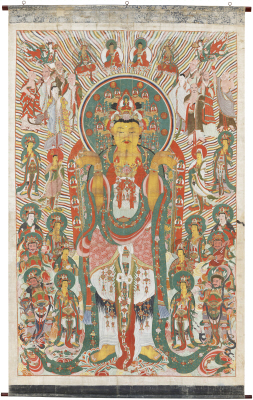
The Rocana Buddha Gwaebul at Sinwonsa Temple(新元寺 盧舍那佛 掛佛幀)
- Date
- 1664년(현종 5)
- Designation Type
- National Treasure
- Monk-Painters
- Eungyeol, Hakjeon, Ilcheuk, Seokneung, [illegible]Han
- Dimensions
- Total 1,083×651cm, Image 951×611.3cm
- Designated Date
- 1997-09-22
- Holder
- Sinwonsa Temple
Overview
This gwaebul painting is a group image presenting Rocana Buddha standing in the center surrounded by a symmetrical configuration of thirty-two figures, including the Buddhas of the Other Realms, Bodhisattvas, apsaras, the Ten Great Disciples, and the Four Heavenly Kings. The monk-painters who took part in the production of this gwaebul include Eungyeol, Hakjeon, and Seokneung. Given the similarities in the composition, iconographical arrangement, and depictions of figures and their clothing with The Rocana Buddha Gwaebul at Sudeoksa Temple, which they also produced in 1673, the same draft appears to have been used here. Rocana Buddha adorns himself with an ornate crown and beaded ornaments and makes the Dharmachakra (turning the Wheel of Dharma) mudra. Inside his head halo is written his name, reading “Perfect Reward Body of Rocana Buddha.” The crown is embellished with nine Nirmana Buddhas (transformation Buddhas). Among them, Vairocana Buddha in the center making the Bodhyangi (wisdom-fist) mudra is depicted larger than others. In the red edge of the body halo, eight Nirmana Buddhas are placed symmetrically. The green outer robe of Rocana is decorated with a Sanskrit character “ ” The Buddha also wears a red undershirt with medallion and scroll patterns and a white skirt-like garment. Above the head halo of Rocana Buddha are two of the Buddhas of the Other Realms and two Bodhisattvas sitting on lotus pedestals and flanked by an apsara holding offerings. On both sides of the head halo, the Ten Great Disciples, including Kasyapa and Ananda, are depicted standing with distinctive appearances. To the left and right of the body halo are Kshitigarbha Bodhisattva and White-Robed Avalokiteshvara Bodhisattva, each with a round head halo, and another pair of Bodhisattvas, each with a green head halo. In the lower portion of the painting are six Bodhisattvas, including Manjusri and Samantabhadra, three on each side of Rocana in three rows. They are flanked by Indra, Brahma, and the Four Heavenly Kings. This painting is characterized by auspicious energy in five colors (black, white, yellow, green, and red) stretching out from Rocana and filling the entire picture plane. No separate cartouches are added for inscriptions, but at the lower-center edge of the painting is an inscription recording donors, producers, and people in charge of different tasks. The end of the inscription indicates that the Great Vulture Peak gwaebul at Sinjeongsa Temple was produced in the sixth lunar month of the Gapjin year (1664). The head monk-painter was Eungyeol, and four other monk-painters, Hakjeon, Ikcheuk, Seokneung, and [illegible]han, took part in the production.
Inscriptions
Yi Man-bok and spouse, who made a considerable donation of materials for the production of a gwaebul painting Bak Ui-nam and spouse, who donated a great volume of goods for public use Jo Yu-suson and spouse, who donated many pieces of cloth for use as a support material for the Buddhist painting(batang*) Monk Baeksin, who donated cloth for use as a support material for the Buddhist painting Donors are Yi Gan-bok and spouse. Donors are Jo Mal-rip and spouse. Donors are Kim Seung-bok and spouse. Donors are Bak Gyeong-su and spouse. Donors are Yi Gil-saeng and spouse. Donors are Ku Cheon-bae and spouse. A donor is Monk Chungeon. A donor is Monk Hyeonhwi. A donor is Monk Yuil. A donor is Monk Gyeonhyeon. A donor is Monk Sangrim. People who participated in the Buddhist project Monk _____jun, who examined whether the Buddhist project was being performed properly Monk Suhyeon, who managed the incense, offerings, and more for the Buddhist altars Those who produced the gwaebul painting are Monk Eungyeol, Monk Hakjeon, Mon Ilcheuk, Monk Seokneung, and Monk _____han. Monk _____, who donated round rings Monk _____ and Monk _____, both of whom procured goods to be used by the public Monk Bojeong, who supervised affairs in the kitchen compound Monk Eonho, who collected a substantial amount of donations Monk Chungil, who assisted the head monk and assumed clerical duties Monk Jeongsu, who assumed three managing or operating positions Monk Samuk, who was responsible for overseeing all the affairs at the temple A gwaebul painting of the Great Vulture Peak Assembly at Sinjeongsa Temple was produced in the 6th lunar month of the Gapjin year (1664). Glossary of Gwaebul Inscriptions * batang 婆幀/基布: Cloth used as a support material for a Buddhist painting